Thursday, May 13, 2010

YPA Counts Down the Top Ten: #9 Bantam Building, Butler County

For the next several days, until May 21, YPA will count down its 2010 list of the Top Ten Best Preservation Opportunities on its blog. On Friday, May 21, YPA will host a Historic Preservation Month Celebration, "Old is the New Green," at the Kelly-Strayhorn Theater in East Liberty, starting at 6:00 p.m.

Registration details are on YPA's website, http://www.youngpreservationists.org.

Since 2003, YPA has celebrated historic preservation with its annual list of the Top Ten Best Preservation Opportunities in the Pittsburgh Area. The list, compiled from nominations received from various individuals and organizations, is designed to encourage investment in historic sites throughout the nine-county southwestern Pennsylvania region. The list has been used by property owners to draw positive attention to their properties, raise investment funds, secure grants, and generate political goodwill for their historic sites.

The sites featured on YPA's list come from six different counties and include industrial structures, Main Street commercial buildings, schools, a train station, and a bridge. Main Street features prominently in the list, with four of the Top Ten sites being situated in an existing Main Street commercial district. The remaining six sites are within blocks of an existing Main Street community.

The criteria used to select the Top Ten List include the following:
1. 50-year Threshold (is it 50 years old or older);
2. Historic & Architectural Significance;
3. Threats to the Site;
4. Community Input; and
5. Feasibility of the Solution.


#9 Bantam Building, Butler County

The Bantam building was built circa 1899-1900 by the Davis Lead Company, which later became the American Bantam Car Company circa 1929. The building’s historical significance came in 1940 when freelance design engineer Karl Probst and the American Bantam Car Company designed the winning U.S. Army prototype for a new Second World War military vehicle. The American Bantam Car Factory was the birthplace of the first jeep, and was commissioned to produce nearly 3,000 jeeps to help with the war efforts.


The Butler County Tourism & Convention Bureau and City of Butler are presently working with AK Steel (current building and property owner) to protect this 10,000-square-foot vacant building from further deterioration.


Several community groups including the Butler County Tourism & Convention Bureau, the Butler County Historical Society, Butler Downtown, and the City of Butler would like to see this building preserved as a reminder of the great importance the jeep played in helping end the Second World War and becoming a brand that is still being used today. In 2010-11 the Butler County Tourism Bureau will be remembering and celebrating this invention with the first Jeep Heritage Festival to mark the 70th year of the invention of the jeep.

Wednesday, May 12, 2010

Old is the New Green

Today, the Young Preservationists Association of Pittsburgh releases the first of its Top Ten Best Preservation Opportunities in the Pittsburgh Area.

Since 2003, YPA has celebrated historic preservation with its annual list of the Top Ten Best Preservation Opportunities in the Pittsburgh Area. The list, compiled from nominations received from various individuals and organizations, is designed to encourage investment in historic sites throughout the nine-county southwestern Pennsylvania region. The list has been used by property owners to draw positive attention to their properties, raise investment funds, secure grants, and generate political goodwill for their historic sites.

The sites featured on YPA's list come from six different counties and include industrial structures, Main Street commercial buildings, schools, a train station, and a bridge. Main Street features prominently in the list, with four of the Top Ten sites being situated in an existing Main Street commercial district. The remaining six sites are within blocks of an existing Main Street community.

The criteria used to select the Top Ten List include the following:
1. 50-year Threshold (is it 50 years old or older);
2. Historic & Architectural Significance;
3. Threats to the Site;
4. Community Input; and
5. Feasibility of the Solution.

YPA’s companion report, “The Economic Impact of Historic Preservation in Southwestern Pennsylvania,” which will be released on May 20, 2010, demonstrates the immense economic impact that historic preservation has had on various communities.


The data show that over the last seven years, more than $80 million has been invested into properties placed on YPA’s Top 10 List. Consequently, this created the following results:

> $1.30 of private financing for every $1 of public investment was generated,

> 1,245 construction and trade-related jobs created,

> production of 230 housing units resulted,

> $750,000 in additional annual wage tax revenue is yielded to state and local municipalities, and

> a total of 401 permanent employment positions were created.


Since YPA’s first Top Ten List was first published, only three sites have been lost.


As YPA’s Top Ten List continues to show, an investment in historic properties is not only good for the economy, it is good for the environment. What better way to save the earth than to reuse what we have already built.


This is important for a new generation concerned with the environment and in search of jobs that cannot be outsourced. That’s the power of preservation!


Over the next nine days, YPA will release its Top Ten List, counting down from number ten, listed below. All Top Ten sites will be published in a special report. In addition, YPA will also release a new report, "Homage to the Fallen," which honors ten buildings we wish we had back.


YPA will release the reports at its Historic Preservation Month Celebration, "Old is the New Green," on Friday, May 21, at the Kelly-Strayhorn Theater, starting at 6:00 p.m.


Registration details are on YPA's website at http://www.youngpreservationists.org/


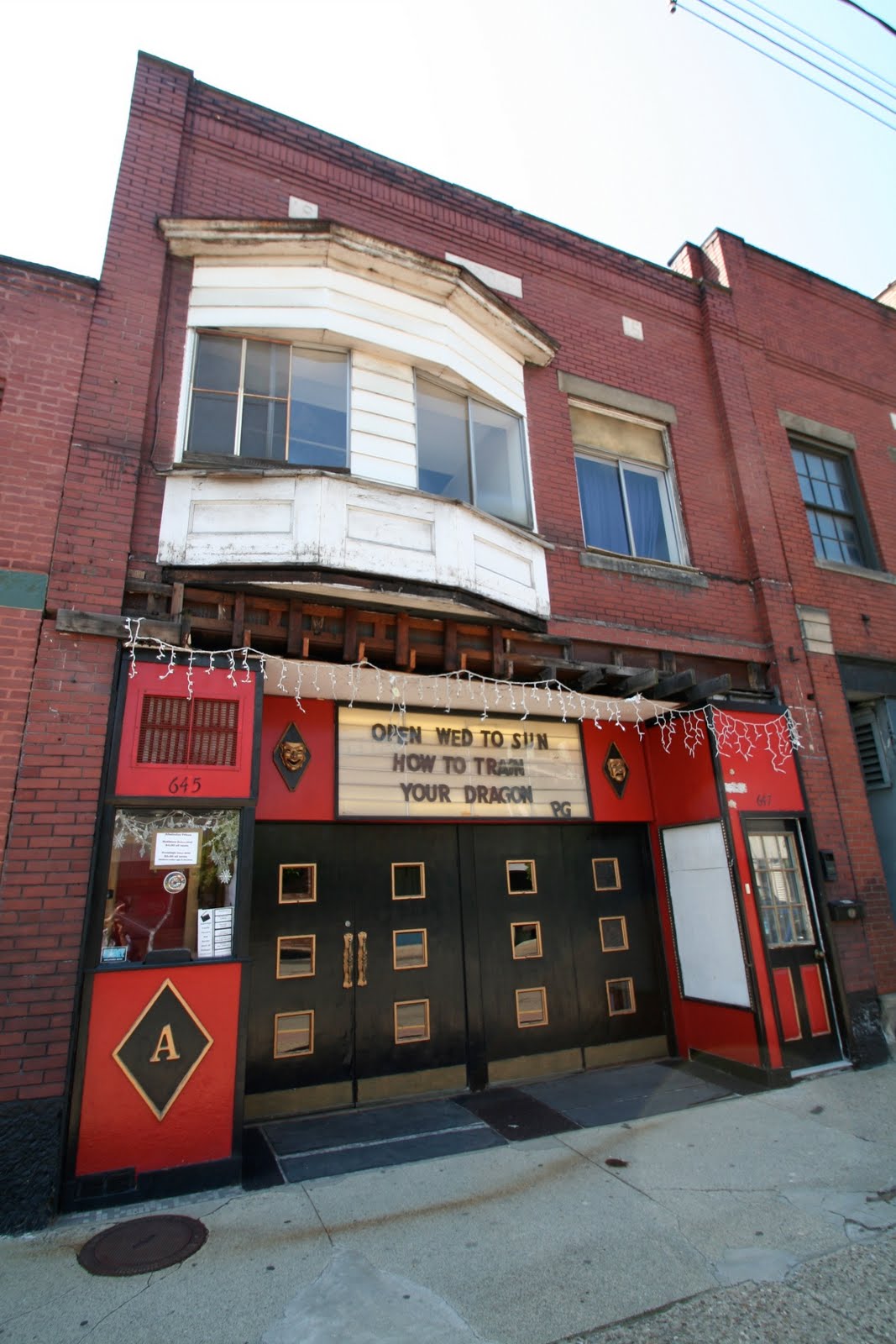
#10 Ambridge Theater

Built in 1915 as a sewing machine store, it was converted into a theater in 1967. It currently seats 167 people. The seats were purchased from the former Pittsburgh Playhouse during one of its renovations, and some of the equipment came from the former “Blue Sky” drive-in theater. It is the last remaining family-owned theater in Beaver County.


Ambridge has suffered lately, with the closure of its major National Historic Landmark, Old Economy Village, which only recently re-opened. But the town has lost many of its residents and young people. Still, there is a lot of vitality and great potential.


The building is in disarray and is in need of much repair. The original marquee has been lost, except for several remaining pieces due to fear of collapse a few years ago. The facility is in need of a new roof and renovation to the upstairs apartments. The fears of water damage affecting the main hall of the theatre are looming. The sound system is rather bare and is still running in mono. A major issue is the restrooms in the facility are not ADA compliant.


The community is proud to have this facility to call their own; unfortunately, crowds to the location are far from overwhelming, mainly due to appearance issues. The community has expressed great interest in seeing this theatre restored to its glory days and the need for a local historical entertainment venue is tremendous.


Wednesday, April 21, 2010

Student Preservation Voices

This is a periodic posting by YPA interns and other students who have worked (or are working) with us. The blog postings, below, are from Michael Bennett, John Yehambaram, and Justin Greenawalt (pictured at left, left to right), who were interns with YPA in the summer of 2009.

Last summer, YPA was fortunate to host three interns from a variety of backgrounds and grade levels: John Yehambaram, a native of Malaysia, will receive his masters degree in History from St. Cloud State University in St. Cloud, Minnesota; Justin Greenawalt, a native of Connellsville, is a masters candidate in Historic Preservation at Columbia University in New York City; and Michael Bennett, a Pittsburgh native, is a Sophomore at Dickinson College in Carlisle, Pa.


Here are their essays, commentaries on historic preservation in southwestern Pennsylvania, and good advice for us all.


"Look Up"

By Michael Bennett


“Look up!” was perhaps the best advice I was given from a teacher in grade school. We were on a stroll around our school to admire the neighborhood’s buildings, and to get our distracted eyes away from the street windows, he gave us that simple command. I can remember doing as he said, and instantly seeing the intricate and beautiful designs that are hidden in the skylines of the Shadyside buildings. I’m neither architect nor artist, and I can’t recognize patterns or styles, but catching my eye is an accomplishment in itself. Since this quite sudden realization, I’ve used the “look up” tool as a rule of thumb to judge buildings-and furthermore, neighborhoods.


Before the summer, Homestead always had a shaky label in my mind. First, it was the street along the way to Kennywood. Then, it became the neighborhood between the Waterfront and Kennywood. Soon after, it was Charlie Batch’s project between the Waterfront and Kennywood. This summer, Homestead took on a much different label, because I finally took the time to look up. My neck hurts after two months of blinkless admiration.


You don’t have to look for long to find the history that resides in Homestead’s Eighth Avenue. Say you catch the dated brick or the trim patterns, or maybe find delight in the decadent Bank or flourish of old local shop windows. You could find a former steel worker that will reminisce about the bustle of the street, and curse the demolition that has become a pattern along the avenue. Even taking pictures of a building has become a forced assumption that the structure will be torn down in the following weeks.


Could it be that these rotting buildings and vacant lots were once bustling with people and storefronts? That this town was a vibrant center of a thriving steel industry? It’s much easier to believe if you look up-but that’s because it makes it easier to ignore the empty windows and garbage filled lots. Still, the history leaves a yearning to restore, recapture, and preserve what’s left-to make it much easier to believe the local stories.


And things are changing; the people, the buildings, the culture of Homestead will not let their history be ignored or forgotten. It may still be behind the scenes, but buildings are being renovated and store windows are being decorated. A coffee shop is brewing and homes are being restored. Homestead’s Eighth Avenue is slowly moving from the droopy shadow of the waterfront, to the restored neighborhood, rich with the history those waterfront plazas so blatantly lack. If people will only stop and look up, as I did at the start of summer, their appreciation of Homestead’s historic remnants will force them to search for more. Looking up is only the beginning, the catch phrase, the hook of the neighborhood.


But with such a great sight above, the neighborhood’s future, with the help of its people, is looking up too.


The Importance of Saving Our History

By John Yehambaram


I moved to Pittsburgh from St. Cloud Minnesota. I’m originally from Seremban, Malaysia. I lived in Malaysia, for 19 years before embarking on a journey to the United States to pursue my higher education. In Malaysia the word preservation never existed in my mind. I was however always amazed in the mixture of architecture in many cities in Malaysia. There are the structures that were inherited from British colonial times, the intricacies of wood carved village houses that predate British colonialism and the modern and post modern architectures like the Petronas Twin Towers in Kuala Lumpur.


When I first arrived in the United States it was on New Year’s eve on a typical Minnesota winter night, - 35F. When I woke up the next morning and opened my window curtain’s all I could see was the color white that glared painfully into my eyes. As the week’s past on and the snow subsided a little, this little town began to reveal its architectural self to me. It like many small towns in the United States had a main street. Most of the buildings had a story to tell of the town’s history, its immigrations, and the transformation of its main street into the center of the town. Winona, Minnesota unlike most cities and towns in Minnesota which were founded by Scandinavian immigrants was established by Polish immigrants. Growth in Winona was built on a railway and steamboat transportation system, wheat milling, and lumber.


In 1856 over 1,300 steamboats stopped at Winona. The railway system grew and the Winona Railway Bridge, built of steel and iron with a steam-powered swingspan over the river, was the second railway bridge to span the Mississippi. The earliest evidence of human habitation in Winona County is based on the discovery of a Woodland period site (circa 800 B.C.-900 A.D.). The present-day city of Winona was founded on the village of Keoxa. As the seat of the Wapasha dynasty, it was home to a Mdewakanton band of the eastern Sioux. Like Malaysia it has its mixture of histories that gives identity to the place. Also similar to Malaysia Winona has its modern identity that it affects it a positive and negative way as well. A Target, Wal-Mart and few other retail outlets that lay on the outskirts of town have affected the growth businesses on the town’s main street and its economic growth. This economic demise in downtown started to take place as I was finishing my undergrad at Winona State University in 2005. What could be done? What has been done? I didn’t know at the time.


After receiving my B.A in journalism, moving to New York to work as a copy editor, going back to school to pursue another B.A in history and a master’s in history back in St. Cloud State University, Minnesota, this was a time where I realized the importance of history and the message it conveys to the societies and societies that precedes it. It’s not only in writing that history is preserved. It’s in everything, music, art, sculptures and building structures.


When I moved to Pittsburgh on December 31st 2008 and got an internship position with the Young Preservationist Association of Pittsburgh. I further realized the potential and importance of history to people. Through its programs of encouraging the younger generation of South Western Pennsylvania to preserve its historic building and monuments and researching on potential structures that could be nominated as a historical landmark it’s helping communities in Pittsburgh have a sense of history. The YPA is trying to help build a newer sense of community in South Western Pennsylvania. Pittsburgh is trying to grow into a greener more environment friendly city.


Historic preservationist groups like the YPA have a role to play reaching this goal. The amount of waste generated through the demolition of buildings is more costly economically and environmentally. YPA is trying to promote the preservation of historical buildings in order to prevent these kinds of waste. We are moving into times where resources for material are becoming scarce but preservation can help in the logistics of limiting the waste of these resources. The life of any city is in its past. YPA is trying to give life back to the history of Pittsburgh for the preservation of its identity and its communities.


There may be a lot of work that need to be done in the preservation of buildings in Pittsburgh. However with organizations like the YPA in Pittsburgh its path to historic preservation is heading towards the right direction. It’s a good example that can be followed in areas in the world where historic preservation of architecture is most needed. Winona, Minnesota needs to revive its main street. Pittsburgh has had some success in reviving main streets in some of its neighborhoods and surrounding areas. Malaysia has had to deal with the call for modernity and to industrialize to catch up with developed nations. But at what cost? Does it have to result in the demolition of buildings of the past to accommodate post modern architecture that creates the illusion of a modern state. Pittsburgh was a city at the heart of industrialization. The steel industry thrived in this city. It also left the city in economic tatters in the late 1980s with the closure of steel mills.


There is still a lot of preservation to be done everywhere. It’s a matter of realizing that in a globalized world everyone can learn from each other especially in the field of preserving historic buildings. Different region, cities and countries may have its own intricacies and politics in preserving potential historic buildings but in the end of the day the whole world is dealing with preserving its natural resources and its environment.


Building preservation has its role to play in this worldly endeavor. I’m glad I’m starting it in Pittsburgh and with the YPA. Pittsburgh has a rich history with the native American tribes of the Allegawis, Adena, Hopewell, Delaware, Jacobi, Seneca, Shawnee, and several settled groups of Iroquois, the creation of Fort Pitt by the British, its involvement in the Independence War and the war of 1812 and the rise of steel mills during the height of the industrial revolution. With this history it has also left monuments, buildings that tell a story of the past. It’s great to be part of a city that has a worldly history and a great starting point to learn about the business of preserving buildings of the past.


For the Love of Old Buildings

By Justing Greenawalt


Truly thought provoking statements are often few and far between. Even less frequent are the comments that really prompt you to look deep into the reasoning behind the choice of a career path or life decision, but it was a comment made at Homestead’s Community Day that managed to make me do exactly that. A local resident, curious about the current projects of the Young Preservationists Association, candidly asked, “How did you get involved with this? You’re not even supposed to know about this stuff.” It was an iteration of a question I had been asked before, but the statement that I should not know about the past, that my affinity for anachronism was somehow odd, was a new addition. My response—typical and reeking of unoriginality--was, “Because I love old buildings.” But this resident’s comment lingered long after she had moved on. What is it to be a young preservationist? To attempt an answer to this question, I provide the reader with my thoughts on the matter through the vehicle of two topics familiar to residents of southwestern Pennsylvania: the Rust Belt and Main Street.


Rust Belt America: a title with unfortunate connotations and one that many residents of southwestern Pennsylvania have either grown-up with or reluctantly settled into. For those unfamiliar with the term, the “Rust Belt” is an area stretching across much of Pennsylvania and into Ohio and even up into Michigan where once prosperous industries have vanished, leaving behind rusting mechanical heaps and expansive brownfields. As a person who grew-up with this title, I did not live at the peak of Pittsburgh’s industrial prowess. Instead, I have grown-up indoctrinated by the stories of the glory days of Pittsburgh and the Monongahela Valley. I have been told of the thick haze that hung over my beloved Pittsburgh and the dreaded experience of atmospheric inversions. I have found myself oddly attracted to the distinct olfactory experience produced by the burning of bituminous coal and reveled in the brute aesthetic force of smokestacks piercing the sky at Braddock and Clairton. But I can never claim this as my own. The legendary Homestead Works closed the year that I was born. As I grew up, the City of Pittsburgh and its once prosperous region, industry fleeing, spiraled downward into what seemed to be a bottomless economic abyss.


As a child, I watched—with little understanding—as my hometown of Connellsville faltered and eventually collapsed; further digging itself into a vicious cycle of disinvestment and self-mutilation. The businesses left Crawford Avenue (our Main Street) for the shopping plaza, the buildings, dilapidated and forgotten, were demolished, and slowly, Connellsville began to lose its essence; the thing that made Connellsville unique from every other small industrial town along the tributaries of the Monongahela. The buildings that remained were reduced to mere curiosities; monuments to a by-gone era surrounded by a sea of vacant lots. This is the stark reality of every young preservationist today. But in being a young preservationist, one generally lacks the one thing that our older colleagues possess: authentic nostalgia.


What do I mean by “authentic nostalgia”? Nostalgia being a feeling of fondness for the irretrievable past, authentic nostalgia, in my definition, is a fondness for places and events that one actually experienced. Most preservationists today wish to see Main Street restored, the businesses brought back, and the title of “Rust Belt” revoked—as do I and the majority of my young colleagues—but whereas older preservationists have their memories to drive their ambitious projects of restoration and preservation, I have only photos, stories, and a sense of the way things “should be”. Granted, we have had people like this forever; we call them “historians”, but historians study the past in an academic and scholarly way; preservationists, although we too are also academic and scholarly, work primarily not in academia, but in the communities with real and tangible buildings.


As a young person, I walk the streets of my city and mourn the loss of a reality I never lived. Those entering the field today, myself included, grew-up in an automotive culture; one in which Main Street and Main Street culture was not dying, but already deceased, one in which the streets and buildings and community were not our classroom, but rather, our living rooms and television sets and computers did the teaching. This, perhaps, is the greatest challenge to young preservationists today, not fighting the good battle to save Main Street, but attempting to convince a generation of people the worth of a concept and a place that both we and they have never known.


The gamut of responses to the mere concept of preservation from members of a community is stunning. My experience alone attests to the apathy on the part of my generation and the great work that we as preservationists have ahead of us. Photographing in Brownsville and Connellsville, PA—both located in Fayette County—the fact that someone, anyone, is interested in these places arouses curiosity and interest in the people who live there. Countless people have approached me on the street to tell me stories of the hey-days of their cities. I was heralded with tales of the movie houses and the soda fountains and the ice cream parlors and the apothecaries and the millineries and the churches, but not one of those stories were told to me by a young person. These were the stories that could only have been spawned by authentic nostalgia. The only response I have ever received from a young person—not directly to me, of course, but to a friend as he passed—was, “They need to tear that down. Who cares, anyway?” I do not claim that this comment is representative of every member of my generation, but it is dangerous thinking nonetheless.


We, as preservationists, are looking at a new breed of historic preservation; one in which the rules are changing and the people involved are characteristically different. In a few, short years, those who proclaim themselves to be preservationists will be attempting to recreate something they have never known. With this, I, as a young preservationist, announce a call to action. The time is now to tell our young people about the past. The time is now to get our young people involved in their communities and in their Main Streets. This is not a job for the History Channel. This is not a job for text books. This is a job for everyone possessing authentic nostalgia. Take a young person aside and tell him or her the stories of yesterday. Bring the old photo albums out of the attic and tell him or her about how things used to be. Take a young person into the community and just look, for there is no greater document to learn from than the living, breathing fabric of our towns and cities. Cultivating an appreciation for the past is something that can never be started too early. I thank those who did these things for me, just as a future young preservationist will thank you.


Justin Greenawalt

Intern, Young Preservationists Association

Historic Preservation Master’s Candidate 2010, Columbia University


Sunday, April 18, 2010

Postscript to "What Does Green Mean"

The demolition of several houses in Squirrel Hill prompted me to write a lament on April 15th about the continued destruction of Pittsburgh's built fabric, its authenticity, its identity.

Well, the good news is that most of the construction waste from the demolition site is being recycled by a local nonprofit, Construction Junction, as reported in the Post-Gazette on April 17th (http://www.post-gazette.com/pg/10107/1051075-30.stm).

If only more demolished properties could be salvaged in such a way. Thousands of properties all across the Pittsburgh region have been torn down and sent to the landfill. Some of these properties had identifiable historical or architectural significance. Many did not. But all of them added up to create a unique identity that is Pittsburgh.

As Pittsburgh tries to forge a new future for itself, as many cities do, it should consider demolishing less; for those buildings which must come down, recycling more.

Much of the demolition has occurred in low-income communities. But nearly all communities, rich and poor, have lost historical treasures and a part of their identity. These before-and-after photos of the Samson Funeral Home is from Shadyside, a high-income Pittsburgh neighborhood. The unique Queen Ann building was representative of Shadyside's early years as a streetcar suburb. The box that replaced it is more reminiscent of, well, anywhere.

Other properties throughout the region were simply demolished. Mann's Hotel, an 1803 wooden structure in McKees Rocks, had sat vacant for years and had been condemned by the city. Instead of selling the property or having it salvaged, the owner simply demolished it in the fall of 2009. Gone is one of the oldest structures along the Ohio Valley.

Demolition, demolition everywhere. In nearly every town, nearly every neighborhood, southwestern Pennsylvania is losing its soul. From steel mills to historic inns and theaters, to plain old houses, are being ripped down and sent to the landfill. Only a tiny percentage are being salvaged and recycled. This isn't green; it's destruction at its worst.

And yet, the region continues to lose people--especially young people--and along with it, its identity, as more and more buildings get torn down.

I'm not against demolition--for the right reasons: to build something great and needed or as an absolute last resort when all options are exhausted. But when it becomes endemic and widespread, like a disease, one must ask the question, when will it end?

One might make the conclusion that demolition is necessary to deal with the contracting population. Some would argue that the population does not exist to support these obsolete structures. I would argue that we as a region are perpetuating the population loss with all the constant demolition. It presents a very unwelcoming sight--vacant buildings uncared for, piles of rubble, or a vacant lot.

What happens if we as a region start to grow again? What will be left upon which to build? What will become of our identity once we rip it all down? What kind of a message does that send to young people in this region?

Demolition, as an option, must be pursued carefully and with proper planning. An inventory of vacant properties must be taken. Thought must be given to what will happen to the property once it is gone. Salvage must be given more consideration. Design standards should be put in place to ensure that new construction is sensitive to the surrounding fabric. And young people as future investors in the community must be engaged.

The unfortunate thing is that few communities have any plan for their future. History is snubbed, buildings get demolished, and young people continue to leave southwestern Pennsylvania. So far, we aren't on the right track.


Thursday, April 15, 2010

What Does Green Mean?


Today, I walked along Forbes Avenue in Squirrel Hill and noticed four beautiful houses about to be demolished. Attached to a chain link fence facing the sidewalk, were the words "Location. Light. Size. Space. Green. Efficient. Luxurious. Beautiful." And a photo of the proposed new development, another cookie-cutter bland box.

The development, proudly sponsored by Coldwell Banker Previews and Terradime ("Tear-it-Down") Development and Sustainability, prominently featured their signs in front.

Green? Who are they kidding? I don't get it.

Why tear down perfectly good old houses and send them to a landfill and build something new and call it "green"?

This issue is partly about waste, partly about good design (or, lack thereof), and partly about leaving a legacy for the next generation.

Here are three facts about waste in America.

1. According to the American Institute of Architects (http://wiki.aia.org/Wiki%20Pages/Construction%20Waste%20Management.aspx), between 20 and 40 percent of all waste is construction debris.

2. According to the Sustainable Sources website (http://constructionwaste.sustainablesources.com/),
8,000 lbs of waste are typically thrown into the landfill during the construction of a 2,000 square foot home.

3. More than 130 million tons of debris from construction sites is dumped in U.S. landfills annually, according to the U.S. Environmental Protection Agency. And more than half of that comes from nonresidential renovation and demolition projects. (http://www.bizjournals.com/boston/stories/2002/06/03/focus1.html)

Even if these homes were demolished and the majority of the materials were recycled, the design of the new structure is horrendous. It does not fit in with the surrounding neighborhood at all.


Lastly, there's the legacy. What kind of message does this send to young people? It's OK to tear stuff down and erect mediocrity? What's wrong with the old stuff, which can become good as new with a bit of restoration that employs local materials and labor?

Furthermore, who in Squirrel Hill allowed this to happen?

It's a shame, really. Using "green" as a cover for demolishing perfectly good houses is a ruse to get people to buy into a project that is really lackluster and wrong for the community.

Unfortunately, in a city that doesn't have that many young people to begin with, it's another nail in the coffin. Why would young people be attracted to a city that puts up crap?


Friday, April 2, 2010

Downloading the Past for Preservation Generation 2.0


Hazelwood was once as vibrant, wealthy, and packed with talent as any community in America. When the mill was running--LTV's Coke Works--living wages enabled men and women to provide for their families, support the business district along Second Avenue, and maintain nice homes.

When the mill closed, work disappeared, and people gave up on Hazelwood. Unable to support the business district, local businesses, like Dimperio's Market, closed. Homes were boarded up and began to decay. Men especially were left adrift, wondering what to do with their skills honed in heavy industry that no longer needed them.

Such is the story of Hazelwood, but also of many industrial towns along the three rivers in the Pittsburgh region. It's a sad state of affairs for many of these company towns. Upon first glance, anyway.

There are hidden gems in these former industrial boom towns. The gems are both the historic buildings and architectural treasures that remain, as well as the people that remain. One must never forget that people still live in these communities, especially young people.


I stood today in front of the Carnegie Library of Hazelwood as a press photographer took my picture. In the yard directly across from the Carnegie, a small African American boy played on his tricycle. It was then that I realized that any effort to restore, revitalize, and re-imagine community assets like the Library must include the dreams and aspirations of young people like that little boy.

One day, he will grow up and most likely leave Hazelwood. But what will he remember? Will he remember the vacant and abandoned historic building across the street? Or will he see it being renovated and witness life come back to one of the first neighborhood Carnegie Libraries built in the United States. Of course, history won't matter much; the future of the building is what matters most. At least to him.

As YPA prepares to focus on four historic sites in Hazelwood as part of the Preserve Pittsburgh Summit on April 10th, we must remember what we are doing this for. It's for the next generation. We cannot, must not, will not let the next generation down.

What do young people in distressed neighborhoods wake up to? What should they wake up to?

These are fundamental questions that all preservationists must ask. It's not just about the buildings, but the people around them that must be engaged to bring them back to life.

YPA also recognizes that there's an older generation that remembers the stories and value of these old buildings. It is therefore essential that younger generation connects with the older generation to ask questions, poke, pry, inquire--to download the stories of the past to bring them back to life in a new way.

This process of downloading the past must be institutionalized so that the older generation doesn't feel threatened or skeptical of young people, who seemingly don't care. Likewise, young people must crack through the wall of history that so many older people guard and let few people through.

YPA challenges both the older generation and the young generations to create a constructive dialogue about the past. Why do this? To continue the traditions, save the stories, and maintain the great things that older generations worked so hard to create. We manifest this work in the form of building preservation--saving old buildings. But we can also see the results by inspired young people, enhanced skills, college diplomas, new jobs, and bright smiles.


I know Hazelwood can come back to life, especially the four buildings featured at the Summit--the Library, the John Woods House (featured at left), Gladstone School, and the Spahr Building. But it can't be done without the help of young and old people working together.

If YPA's Summit can inspire at least one person to make a difference in his or her community, then we will have been successful. Let's keep downloading history for Preservation Generation 2.0. Pres Gen 3.0 isn't far behind.

Monday, March 8, 2010

Keeping the Legacy Alive

YPA was founded on the premise that young people are the key to the future, and investing in our young people by passing along valuable information about the past is critical.

Some come to me and ask, "how old do you have to be to be a young preservationist"? I respond, "everyone who supports the next generation is a young preservationist." We don't discriminate on the basis of age or any other human characteristic. We have a commitment to intergenerational dialogue.

As much as I spend working with young people--students and young professionals--I also spend a lot of time talking with those older than me. They have fascinating stories to tell. It inspires me to keep their legacy alive, and it should inspire you, too.

The older generation remembers. They remember what it was like before desegregation, when war really did mean a cutback in the materials and energy we were allowed use, when recycling was just a matter of course, and before the car culture scattered our society to far-flung places and took down so many buildings.

Of course, we cannot preserve people, but we can preserve their memories, and we can preserve the buildings in which these memories took place. The built environment is the physical manifestation of our generational legacy. From the soaring cathedrals and monuments, to the modest homes of great people, it is our duty to keep their legacy alive.

There have been many people who have inspired my work, but three people in particular push me to preserve their legacy: my father, David Lewis, and Barbara Edwards Lee. All three have worked hard to pass along their knowledge and experiences to the next generation. Actually, there is a fourth person whom I'll mention last.


My father, Harry Holland, was an artist, and he gave me the ability to articulate and pursue my vision. I had the good fortune of having had a fond and respectful relationship with him until his death, in 1994, when I was 25 years old. His perseverance, vision, and ability to express his deepest emotions and dreams in art inspire me to do the same, even if I'm not an artist in the traditional sense.

My father was also an innovator. He created one of the first computer painting and drawing programs to be used in a university art program. His work has been recognized by the Siggraph art show and others in the field. But like any artist, he pursued his dream to simply create art as a way to satisfy his quest for amazement, which, to him, was the purpose and value of art.

He also taught me how to run (and, perhaps by extension, to love the post-run beer). It is through running that I have gotten to see many of the great sights--from the Grand Canyon, to the top of Mt. Elbert in Colorado, to the varied and diverse neighborhoods around our region--all on foot. Running also gives me the balance I need to think clearly and stay focused on those things that are important to me.


Architect David Lewis, who created Urban Design Associates Architects and CMU's Urban Lab Program, is also a visionary, and over the past several years that I have grown to know him, the more I believe that he is also trying to keep alive a tremendous legacy in the next generation. He is an artist, preservationist, and man of the world.

More than anything, David is a gifted storyteller. He will have you riveted to a long, drawn out story that fascinates as much as it entertains. And then at the end of the story, he'll have you doubled over in laughter with a funny punchline. His work is serious stuff; David has done much to create better ways to remake cities. But he is far from serious.

David has a humorous undercurrent that sometimes catches you off guard, but always seeks to make you have a good chuckle. It's good for the soul. Isn't that what we are here for--to make each other laugh and feel good about ourselves?


And there is Barbara Edwards Lee, the former National Secretary of the National Negro Opera Company, who lives in a nursing home in Clairton. Over the years, I have sought her out to gather stories of her work with Mary Cardwell Dawson (Barbara's aunt), who created the first black opera company in the nation right here in Pittsburgh. The NNOC went on to perform all across the nation to great acclaim before Madame Dawson succumbed to a heart attack in 1962.

But the memories survive, and so does the house where it all took place--7101 Apple Street in Homewood. Mrs. Lee didn't spend much time there. After she graduated from Taylor Allderdice High School (my alma mater, too!), she became discouraged with the segregated job market in the Pittsburgh area and moved with Madame Dawson to Washington, DC, in 1943. There, Barbara served as the National Secretary to the company. To think that it all started right there on Apple Street is amazing.

These stories need to be kept alive for new generations to appreciate and enjoy. There are lessons in the stories, unbelievable feats of courage, and funny punchlines. The people who continue to make them real after the human body has come to rest are the young people who keep them alive and save the places where these memories took place.


The fourth person who has influenced me over the years is Stanley Lowe, the former Housing Authority director, former vice president of the National Trust for Historic Preservation, and perpetual advocate for his neighborhood of Manchester, on Pittsburgh's North Side. He tirelessly and fearlessly pursued the dream of restoring his neighborhood back to what it once was, or could be, by saving as many old buildings as possible. He was also an important mentor to me, providing me encouragement and feedback on my career.

Just a few months ago, he hung in the background as the mayor and other dignitaries cut the ribbon on a new multi-million-dollar housing development in Manchester, where an electric company once stood. And to think that last summer, Stanley was fighting for his life in the emergency room, the victim of a senseless attack. The lesson is: don't try to keep down a man with vision and drive.

And isn't that the lesson from all four people I've mentioned, only one of which has passed away? All four had a dream, all four worked hard to achieve that dream, and all four never gave up on that dream.

Their memories persist with me and those whose lives they have touched. YPA's mission isn't just about involving young people for the sake of young people. But for the sake of everybody. After all, unless we connect the two disparate generations, we have no past, and no future. We only have the present.

Young people are valuable carriers of our legacy, and it is in them that we must invest.